
The Hidden Years: Rethinking Florida’s Building Inspection Cycle

Florida’s Next Building-Safety Reform Should Start at the Surface

By Miguel Serrano, Brahman Developments LLC
Florida's response to the Surfside tragedy made oversight of aging buildings stronger. Covered condominium and cooperative buildings generally face milestone inspection at 30 years and every 10 years afterward, with local authority for an earlier 25-year milestone where conditions warrant it. South Florida programs vary, but the direction is clear: buildings should be examined earlier than under the former 40-year model.
That leaves a practical question worth exploring: what should owners observe during the years between formal inspections? Buildings do not wait for an anniversary to age. Concrete, sealants, primers, coatings and metal respond continuously to sun, rain, humidity, salt-bearing air, temperature and movement.
Concrete moves. Coatings age.
Some concrete cracking is expected. Concrete contracts as it cures and dries and expands and contracts as temperature and moisture change. When reinforcement, foundations, adjoining construction or geometry restrain that movement, cracks may develop. That does not mean every crack is dangerous. Significance depends on location, pattern, depth, movement, leakage history and structural context - judgments for a qualified architect or engineer.
A crack can still matter to maintenance even when it is not structurally significant. If it passes through paint, sealer or waterproofing, it interrupts the protective surface. Water may reach the material below, a repair may reopen, or a coating may separate around the area. In coastal exposure, the possibility deserves attention without alarm.
What the public calls paint is better understood as a system: preparation, repairs, primer or sealer, intermediate coats, an elastomeric or weather-resistant finish, waterproofing at horizontal surfaces and sealants at joints and penetrations. A failure that looks like bad paint may begin with moisture, a weak surface, an active crack, inadequate preparation, an incompatible repair or corrosion beneath the film.
How a small breach can progress
Imagine a narrow crack forming in an exterior concrete wall. It may not indicate structural trouble. But if it continues through the coating, wind-driven rain can wet the opening and recurring movement can prevent a superficial patch from staying closed. The surface may dry while moisture remains within the crack or behind the finish.
With repeated wetting, mineral deposits may appear, a repair may lose adhesion or paint may blister. In salt exposure, moisture can carry chlorides farther inward. If reinforcing steel later begins to corrode, the expanding corrosion products can place pressure on the surrounding concrete. Rust staining, delamination or spalling may become visible long after the original breach. The sequence is not inevitable, and no single surface sign proves what is concealed. It does explain why change over time deserves documentation.
Concrete and steel: a useful comparison
Concrete can absorb and transmit moisture through pores, cracks and joints. Embedded reinforcing steel depends partly on the surrounding concrete for protection. A coating or waterproofing layer can help reduce exposure, but it cannot correct every underlying crack, void, drainage problem or failed joint.
Exposed steel relies more directly on a continuous protective film.
Breakdown often begins at an edge, weld, fastener, connection or impact point where coverage is thin or damaged. Once metal is exposed, corrosion can spread beneath the surrounding coating. Simply covering visible rust may improve appearance while leaving the process active.
The materials behave differently and require different technical responses. The management lesson is the same: locate breaches, compare them over time, preserve the history and involve the appropriate professional before choosing a repair.
Why South Florida deserves attention
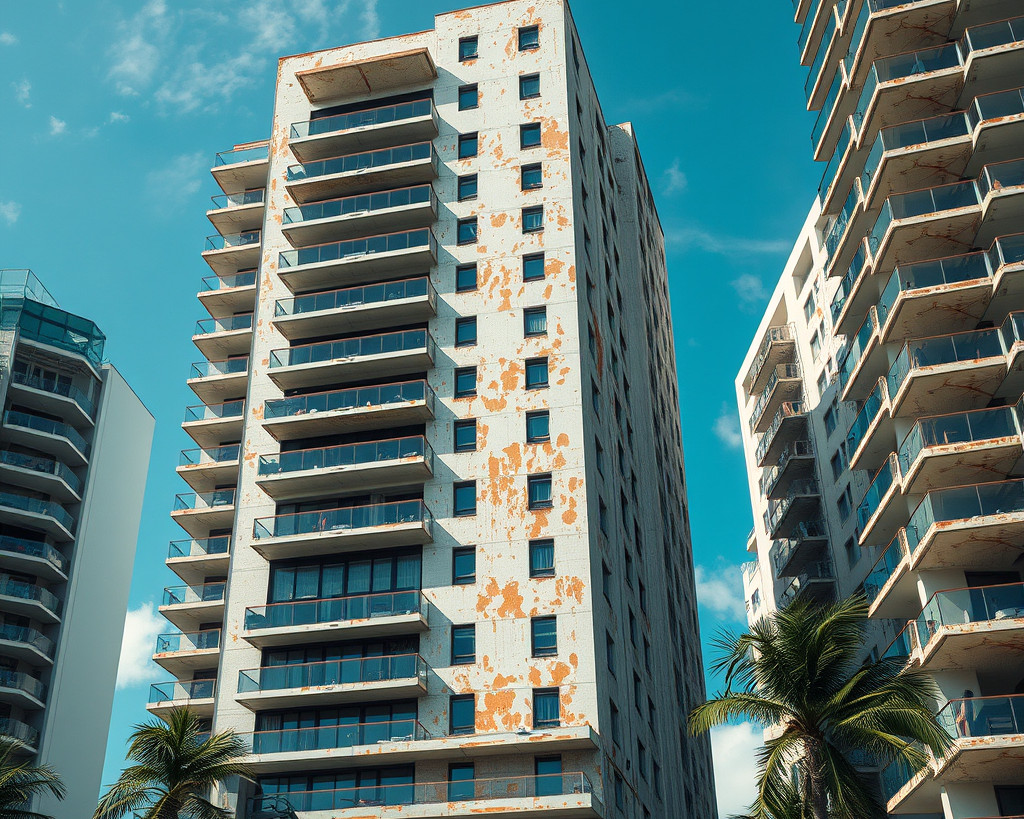
A coastal tower, inland condominium, open garage and sheltered commercial building will age differently. Even elevations on one building face different sun, shade and moisture. Balconies, pool decks, parapets and garages encounter different combinations of water, heat, chemicals and salt.
South Florida nevertheless places recurring demands on exterior materials: strong ultraviolet exposure, high humidity, wind-driven rain, tropical storms, wet-dry cycling and, in many locations, salt-bearing air. Windows, railings, joints, penetrations and deck edges bring unlike materials together at thousands of small transitions. These conditions do not prove that five years is correct for every building. They make the region a reasonable place to test the idea.
The region also contains many multistory buildings managed by volunteer boards, professional managers, institutional owners and public agencies with different resources. Exterior work may require balcony access, resident notices, swing stages, traffic control, parking closures, temporary protection and permits. Timing is therefore operational as well as technical.
A lighter checkpoint between major inspections
The proposal is a five-year Protective Envelope and Coating Condition Review for appropriate aging or exposure-sensitive buildings. It would be narrower than structural recertification and would not replace a milestone inspection.
A practical review could start with prior reports, warranties, maintenance invoices, repair records and known leak locations. The observer could photograph defined elevations and recurring details, record apparent changes and identify inaccessible areas. The same locations would be revisited during the next cycle.
The checklist might include new or changing cracks, coating breaks, failed sealants, rust staining, efflorescence, peeling, blistering, exposed metal, waterproofing, drainage and ponding. Results could remain simple: monitor, maintain, obtain professional evaluation or take urgent protective action.
What it would - and would not - do
The review would create a consistent record and help identify conditions that deserve attention. Leakage, spalling, exposed reinforcement, active movement or significant corrosion would be referred promptly to the appropriate licensed architect or engineer.
It would not certify structural safety, calculate remaining service life, diagnose concealed conditions or select a universal coating system. It would not authorize an owner's representative or coating contractor to practice engineering. It should not become an automatic sales tool for repainting, and coating age alone should not dictate replacement.
The limits matter. A visual checkpoint cannot find everything behind a wall or coating. Its purpose is not certainty. Its purpose is a better baseline, a repeatable comparison and a clear path for escalation when observations warrant professional judgment.
The owner's operational and financial interest
Exterior deterioration affects budgets, reserve planning, access, insurance discussions and resident communication. A modest repair can become disruptive when it requires engineering, permits, swing stages, traffic control or balcony entry. Mobilization and access can represent a substantial share of project cost.
Earlier identification may allow an owner to investigate, budget and coordinate work deliberately rather than respond after leakage, spalling or a major inspection compresses the schedule. It may also show that a condition is stable and requires monitoring rather than immediate intervention. Better information supports action and restraint.
Documentation also survives turnover. New board members, managers and consultants can see what was observed, where it occurred, what was repaired and whether it returned. A five-year photo history cannot guarantee lower costs or prevent every failure, but it can replace memory and disconnected invoices with a usable record.
An invitation to examine the idea
A pilot should begin with evidence, not certainty. How often would the review identify useful conditions? How many would require ordinary maintenance, and how many professional evaluation? Would a documented history improve repair planning? What would the cost and administrative burden be?
Owners can describe the budgeting and access realities. Engineers and architects can define escalation triggers and professional boundaries. Building officials can help shape a practical checklist. Coating manufacturers and qualified contractors can explain what product data and field observations can - and cannot - establish. Insurers can contribute a risk-management perspective. Legislators can determine whether the evidence supports voluntary guidance, a targeted program or no mandate.
The goal should not be to label every crack dangerous or every coating defect structural. Nor should every surface condition be dismissed as cosmetic. The useful middle ground is disciplined observation followed by proportionate action.
Florida has already reconsidered when major inspections should occur. It may now be worthwhile to study what owners should document between them. Concrete movement is ordinary. Coating weathering is ordinary. The open question is whether a predictable, limited observation cycle could help South Florida owners respond earlier and more intelligently.
Notes and authoritative sources
Accessed August 6, 2026. Links are provided for reader verification.
1. Florida Statutes § 553.899. Statewide milestone-inspection scope, timing and professional qualifications. Source
2. Miami-Dade Building Recertification. Current local timing and structural-glazing guidance. Source
3. Broward Building Safety Inspection Program. Current county program materials. Source
4. Palm Beach County Milestone Inspections. Unincorporated county applicability and process. Source
5. American Concrete Institute, corrosion FAQ. Concrete alkalinity, chloride exposure and reinforcing-steel corrosion. Source
6. ACI 222R-19. Protection of reinforcing steel against corrosion. Source
7. ACI 224R. Restrained shrinkage, ordinary concrete movement and cracking. Source
8. ACI 209.1R. Typical long-term shrinkage and influencing factors. Source
9. AMPP, protective coatings. Barrier and corrosion-control functions of coatings. Source
10. ASTM D2370. Coating elongation, tensile strength and stiffness. Source
11. ASTM D7234. Coating adhesion on concrete. Source
12. NIST, Champlain Towers South updates. Official investigation status and technical findings. Source
Comments